Plan
Three to six months,dated.
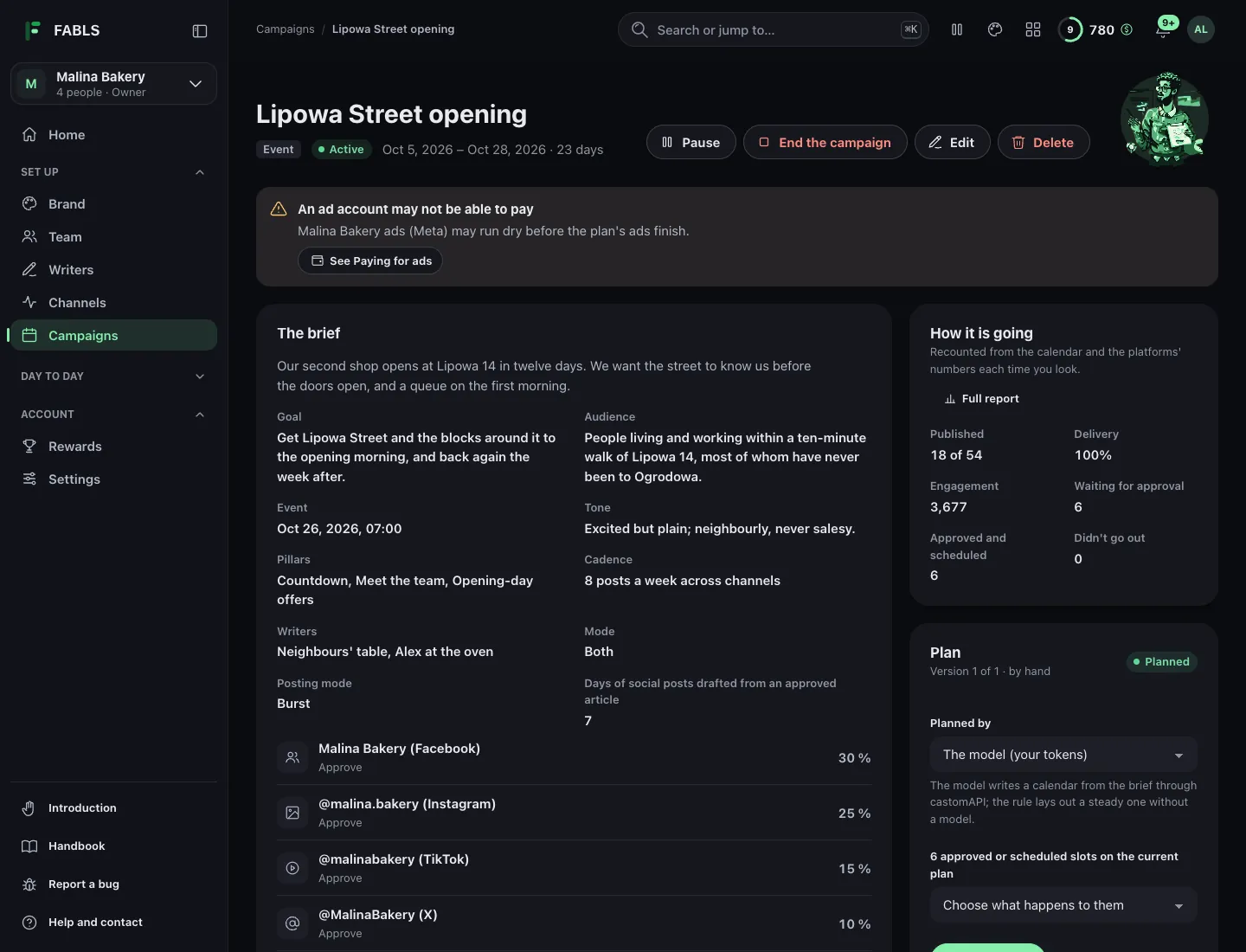
A plan is the difference between a business that publishes and a business that publishes for a fortnight. You set out what should be covered, how often you want to appear and where, and it compiles into a calendar of dated slots — each one belonging to a channel, a theme and a writer.
 Horizon
 Themes
 Shares
 Quiet stretch
 Run-up
 Open slots
What you decide,
and what it works out.
You decide four things. The horizon — three months if you are starting, six if you know your year. The themes: the handful of subjects your business is genuinely about, which for most people is fewer than they expect and more specific than they first write down. The cadence: how often you want to appear on each channel, which is a decision about your capacity to approve as much as anything else. And the shares: how the effort divides between the channels, always adding to a hundred, so that adding a channel is a real trade rather than a wish.
What the plan works out is everything after that. Which theme has not been covered for six weeks. Which channel is behind its share. Which week is short because of a holiday. Where a long piece needs a run-up. It turns those into dated slots, and a dated slot is a thing you can look at, disagree with and move.
The honest bit: the first plan is usually wrong about cadence. Almost everybody asks for more posts than they can face approving, discovers it in week three, and halves it. That correction is expected — the plan is easier to thin out than to keep up with.
Seasonality that is yours,
not a template's.
Every business has a shape to its year and it is rarely the one a generic calendar assumes. A bakery's December is not a software company's December. A fitting company is busy when the weather turns, a clinic when it turns the other way, and an accountant has two months that swallow everything.
You tell the plan about those stretches — busy, quiet, closed, or a period that matters for a reason nobody outside your trade would guess — and it plans around them. Quiet months get lighter and more evergreen; the weeks before your season get the pieces that need to be published in advance to be any use.
The result is a plan that does not ask you to approve four posts in the week you have no time, which is the single most common reason this kind of thing gets abandoned.
- 1HorizonMarch to August. 78 slots across three channels.
- 2ThemesCraft 40% · Practical 35% · Seasonal 25%. Balance tracked, not guessed.
- 3SharesInstagram 45% · Facebook 35% · Blog 20%. Adds to 100.
- ·Quiet stretchLate July marked quiet. Cadence drops, evergreen pieces move in.
- 4Run-upThe long piece for September is dated for the second week of August.
- 5Open slotsSix left deliberately empty, for whatever the month actually brings.
Every slot has a date, a channel and a writerMove one, the rest holds
Two kinds of plan
Coverage,
and events.
Most of what a business publishes is coverage: keeping the channels alive and the themes turning over. Some of it is not, and forcing both through the same shape is how campaigns end up looking like filler.
A coverage plan
Runs for months. Spreads themes evenly, respects your cadence and shares, and fills the calendar without you thinking about it. This is the one that keeps the lights on, and it is the one you leave running.
An event campaign
Has a date it is pointing at — an opening, a launch, a sale, a season. It works backwards from that date: the announcement, the build-up, the day itself, the afterwards. It sits on top of the coverage plan rather than replacing it, and it ends.
Strategy first
Decide what to say
before you decide when.
A calendar answers "when". It cannot answer "what for", and a plan that does not know what it is for fills its slots with whatever is easy. So above the plan there is a strategy for the brand: goals with monthly targets, who the audience is, how the effort divides between channels, and how much of it each theme gets.
The AI can propose a strategy from what it knows about the business, and nothing is saved until an owner or a manager saves it. Each save is a new version, so the brand keeps what it used to believe. The planner and every draft read the current one, and the month's targets are set against the numbers FABLS has collected.
- 1GoalsMonthly targets for reach, followers, link clicks and leads.
- 2PersonasWho is being spoken to: a few lines each, not a paragraph of adjectives.
- 3Channel mixHow often on each platform, recommended from a per-platform guide.
- 4Pillar weightsCraft 40% · Practical 35% · Seasonal 25%. Adds to 100.
Saved as versions by a personRead by planner and drafts
What the calendar knows
The year, the hour,
the ideas and the budget.
Four things the planner reads before it dates a slot, and one thing it learns from every month it has already planned.
- OccasionsThe public holidays and commercial days of the brand's country, plus its own dates, such as an anniversary or a launch. The planner gets the ones inside its span, and the report charts mark them.
- The best time to postRead from the channel's own posts once it has twenty measured ones, and from a starting default, marked low confidence, until then. It chooses an hour where the cadence leaves a choice. Nothing already scheduled moves.
- An idea backlogTopics worth a post, kept per brand and dropped onto the calendar. The writer can add ideas from the brand's facts and memory, and from what is trending and what the pages that rank for your topic say; the cost in tokens is shown before you press.
- Paid slotsOn a campaign set to ads or both, the planner places paid slots too, boost picks and ad flights, that spend each channel's share of the budget, inside the campaign's cap.
- What worked last monthExtending or re-planning reads the brand's memory and the tests it has run, so month two is planned from month one. Test slots are scheduled by the planner as well.
A plan you can argue with
Once compiled, the plan is a calendar. You can open the second week of November today and see exactly what is meant to happen: which channel, what time, which theme, which writer. You can move a slot, delete one, add one, swap the writer, or empty a whole week because you will be away.
Changing something does not quietly reshuffle everything else. A moved slot is a moved slot; the theme balance updates, the plan tells you if a share has drifted, and nothing you already approved is touched. Nothing is substituted in silence: a post that did not go out is shown in the platform's own words, and an emptied week stays visibly empty.
Leaving gaps is normal and encouraged. A plan that fills every day of six months is not a plan, it is a treadmill, and the empty slots are where the things that actually happen to your business go.